

Open Fire and Safer Burning
In this section, learn more about the venting index, outdoor stoves, Category 1, 2, and 3 fires, and offences and fines.
-
Venting Index
Before you burn, you must check the Ventilation Index which changes daily based on:
The location in the province
The atmospheric conditions
The Ventilation Index is a forecast released daily by the Ministry of Environment and Parks from data provided by Environment and Climate Change Canada (ECCC).
It estimates how well the atmosphere disperses smoke on any given day.
The index is similar to a weather forecast, except it provides information on how well smoke will mix into the air.
To predict ventilation index, ECCC uses the High-Resolution Deterministic Prediction System (HRDPS) model to calculate a Calibrated Ventilation Index (CVI). The province then uses the CVI to publish venting conditions across pre-defined venting areas in B.C.
Forecast categories
Ventilation index forecast
Ventilation index
Ventilation category
Poor: 0-33
Fair: 34-54
Good: 55-100
The forecast is broken down into Good, Fair and Poor ventilation.
To start a burn in most populated areas of the province, a Ventilation Index of Good is required.
Often in the winter, there are long periods of time where the ventilation index is Poor. During these times, please be patient and check conditions daily. More favourable ventilation is often seen in the fall and spring or ‘shoulder’ seasons of burning.
-
Outdoor Stoves
An outdoor stove, as defined in the Wildfire Regulation, refers to an open fire device that:
Is used outdoors for cooking, heat or ambience
Burns charcoal briquettes, liquid or gaseous fuel as the fuel source
Is certified by the Canadian Standards Association (CSA) or the Underwriters Laboratories of Canada (ULC)
Has a flame height less than 15 cm
Outdoor stoves may include devices such as:
Propane campfires
Camp stoves fueled with gas or briquette
Gas and briquette barbecues
Pizza ovens fueled with gas or briquette
Any person using an outdoor stove must:
Not light an outdoor stove when outdoor stoves are prohibited
Only light a fire in an outdoor stove if conditions are safe and will continue to be safe
Take reasonable precautions to ensure the fire is contained in the stove and the fire is fully extinguished before leaving the area
Carry out fire control immediately if the fire spreads out of control beyond the outdoor stove and report the fire as soon as possible
During category 1 campfire prohibitions, only outdoor stoves that meet the standards described above may be used.
To reduce wildfire risk when using an outdoor stove, follow these basic safety tips:
Operate the device as specified by the manufacturer's safety instructions
Ensure the device is on a non-combustible surface
Create a fuel break by removing any flammable material within one metre of the device
Always be sure to turn the device off and ensure the fire is completely extinguished before leaving the area
Never dispose of hot cools; ashes must be cool to the touch before being disposed of
-
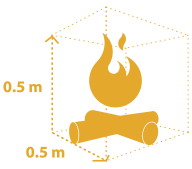
Category 1 - Campfire
A category 1 campfire, as defined in the Wildfire Regulation, refers to any fire that is:
No larger than 0.5 metres high by 0.5 metres wide
Used for recreational purposes or by a First Nation for ceremonial purposes
Any person burning a category 1 campfire must:
Not light a fire during a category 1 campfire prohibition
Only light a fire if conditions are safe and will continue to be safe
Establish and maintain a fuel break around the category 1 campfire
Have at least one person watching the fire that is equipped with at least one firefighting hand tool or 8 litres of water
Ensure the fire is fully extinguished before leaving the area
Carry out fire control immediately if the fire spreads beyond the fuel break or becomes out of control and report the fire as soon as possible
During a category 1 campfire prohibition, only CSA and ULC approved devices which use charcoal briquettes, liquid or gaseous fuel as the fuel source may be used, and flame length must not exceed 15 cm. Under extreme conditions, these devices may be prohibited as well.
Before you burn:
Check to see if there is a category 1 campfire prohibition in your area
Check with your local authorities for any bylaw restrictions before lighting a fire of any size
If you are planning for a fire larger than 0.5 metres by 0.5 metres, you must comply with the conditions specified in the Wildfire Regulation for category 2 or category 3 open fires
Check the current and forecast weather conditions. If it's windy or wind is in the forecast, don't burn
Choosing your location:
Your fire should be on level ground that is a safe distance from tent walls, shrubs, trees or other flammable materials
Do not build your fire beneath low-hanging branches
Use a rock ring, fire pit or other non-flammable barrier around the fire to prevent it from spreading
Create a wide fuel break around your fire by scraping the area around your fire down to bare dirt to remove any flammable material
During your burn:
Maintain your campfire to a size no larger than 0.5 metres high by 0.5 metres wide
Have at least one firefighting hand tool or 8 litres of water on hand to extinguish the fire. A firefighting hand tool could be a shovel, axe, Pulaski, backpack pump or fire extinguisher
Never leave your campfire unattended for any amount of time
Extinguishing your campfire:
Before you leave the area or go to bed for the night, your fire must be fully extinguished
When you are ready to put your fire out, pour lots of water on it, stir the ashes, then pour more water on it. Continue doing so until the ashes are cool to the touch
-
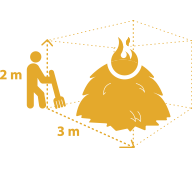
Category 2 - Open Fire
A category 2 open fire, as defined in the Wildfire Regulation,refers to any fire that burns:
Material in one pile not exceeding 2 metres in height and 3 metres in width
Material concurrently in 2 piles, each not exceeding 2 metres in height and 3 metres in width
Stubble or grass over an area that does not exceed 0.2 hectares (2,000 square metres)
Any person burning a category 2 open fire must:
Not light a fire during a category 2 open fire prohibition
Only light a fire if conditions are safe and will continue to be safe
Establish and maintain a fuel break around each pile, grass or stubble area to be burned. See Policy 9.12 for more information on fuel breaks
Ensure the fire is watched by at least one person equipped with a firefighting hand tool to keep the fire from spreading beyond the fuel break
Have a fire suppression system adequate for fire control available near the burn area. A fire suppression system means a system for suppressing fire by delivering water, a suppressant, a surfactant, or any combination of these substances
Carry out fire control immediately if the fire spreads beyond the fuel break or becomes out of control and report the fire as soon as possible
Ensure the fire is extinguished before leaving the area for any amount of time
Smoke is a health hazard regulated under the Open Burning Smoke Control Regulation. On the day you are planning to burn, check the Ventilation Index Interactive Map to view conditions in your area and see if burning is allowed.
Category 2 open fire is one of the leading causes of wildfire in the spring. To reduce this risk, follow the steps below for safer category 2 open burning.
Before you burn:
Check to see if there is a category 2 open fire prohibition in your area
Check with your local authorities for any bylaw restrictions before lighting a fire of any size
To reduce risk and smoke, consider whether you need to burn at all. Other options may include composting and chipping; contact your local government for alternatives to dispose of yard debris
Check the current and forecast weather conditions. If it's windy or wind is in the forecast, don't burn
Choosing your location:
Your fire should be a safe distance from buildings, shrubs, trees or other flammable materials
Do not build your fire beneath low-hanging branches
Create a wide fuel break around your fire by scraping the area around your fire down to bare dirt to remove any flammable material
During your burn:
Ensure at least one person is equipped with a firefighting hand tool for fire control. A firefighting hand tool could be a shovel, axe, Pulaski, backpack pump or fire extinguisher
Have a fire suppression system adequate for fire control available near the burn area. A fire suppression system means a system for suppressing fire by delivering water, a suppressant, a surfactant, or any combination of these substances
Never leave the fire unattended for any amount of time
Extinguishing your burn:
Ensure your fire is fully extinguished before you leave the area
When you are ready to put your fire out, pour lots of water on it, stir the ashes, then pour more water on it. Continue doing so until the ashes are cool to the touch
-
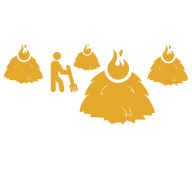
Category 3 - Open Fire
A category 3 open fire, as defined in the Wildfire Regulation, refers to any fire that burns:
Material concurrently in 3 or more piles, each not exceeding 2 metres in height and 3 metres in width
Material in one or more piles, each exceeding 2 metres in height or 3 metres in width
One or more windrows, not exceeding 200 metres in length or 15 metres in width
Stubble or grass over an area exceeding 0.2 hectares (2,000 square metres)
Burn registration
Anyone planning on lighting a category 3 open fire or category 4 resource management open fire is required to register their burn with the BC Wildfire Service and obtain a burn registration number. Burn registration numbers are logged into the Open Fire Tracking System (OFTS), along with details about the registered burn.
The registration number is not a burn permit. The BC Wildfire Service does not issue permits for burns. However, local governments may require permits for burns within their jurisdiction. It is the responsibility of the person conducting the burn to check with local authorities about local bylaws and permit requirements.
Burn registration numbers are normally issued for a period of two weeks. If your category 3 open fire will not be extinguished within that time, your burn registration number may be renewed by calling 1-888-797-1717 or by emailing HPR.1800@gov.bc.ca.
How to register a burn
To obtain a burn registration number, please complete the ONLINE BURN REGISTRATION FORM. This is the fastest way to obtain a burn registration number.
If you are unable to complete the online form, email us at HPR.1800@gov.bc.ca or call 1-888-797-1717 with the following information:Contact information for yourself and/or the company you are burning with. The contact person must always be available during the burn
Details of your burn, including the number and/or size of piles, windrows, grass or stubble areas being burned
Legal descriptors and coordinates or residential address of the burn location
If you send your request via email, please provide a phone number in case the BC Wildfire Service needs to contact you for further details.
Please note that simply emailing the BC Wildfire Service does not fulfill the requirement for obtaining a burn registration number. You must receive a response with a number and notice that your registration number is active.
Legal descriptors
If burning on private property, you must provide two different legal descriptors for the property. These can be found on Property Assessments or Tax Papers. Please note, a residential address cannot be used as a legal descriptor.
-
Offences and Fines
Anyone found in contravention of an open fire prohibition may be issued a ticket for $1,150, required to pay an administrative penalty of $10,000, or, if convicted in court, fined up to $100,000 and/or sentenced to up to one year in jail.
If your fire causes or contributes to a wildfire, you may be fined up to $1 million and/or sentenced to up to 3 years in jail, as well as be responsible for all firefighting and associated costs. More information about the Wildfire Act and Regulation is available online.
For information on open fire prohibition offences and fines, read the summary of wildfire-related offences and fines in B.C.
Why prohibit open fire
Open fire is the largest cause of human-caused fires provincially. Human-caused wildfires are entirely preventable and may divert crucial resources from naturally occurring and/or existing wildfires. Prohibitions are a useful tool used to reduce the likelihood of more human-caused fires in anticipation of increased lightning-caused fires or during critical fire situations.
British Columbia is a large and geographically diverse province. For that reason, each of B.C.’s six regional fire centres decide when and where to implement open fire prohibitions within their respective jurisdictions. The fire centre may consider:
Level of fire activity in the fire centre
Long- and short-range weather forecasts
Risk of human-caused fires
Fuel types
Fuel volatility
Availability of firefighting resources